Guides · · 6 min read
Per-minute or per-call answering service pricing: which costs less for 100 calls a month?
How per-minute and per-call answering service pricing compare, the one number that decides which is cheaper for you, and a worked example with 100 calls a month.
By the Global AI team
Neither model is cheaper on its own. Per-minute pricing costs less when your calls are short, per-call pricing costs less when they run long, and the number that decides it is your average call length. Work that out from your own phone history before you compare any two price sheets.
This post is a close-up of one slice of the bigger picture. For the full set of fees and models, start with our guide to what an answering service costs.
What is the real difference between per-minute and per-call pricing?
A per-minute service bills for the time the call lasts. A per-call service bills one price for each call it answers, however long it runs. That's all of it, and yet owners compare the two by looking at which number is smaller, which tells you nothing. A dollar a minute and two dollars a call are not comparable until you know how many minutes a call takes.
Here is the break-even. Divide the per-call price by the per-minute price. If your average call is longer than the answer, per-call pricing wins. If it's shorter, per-minute wins. A plumber's office that mostly hears "are you open Saturday?" lives under that line. A roofing company that gets long talks about insurance and damage lives over it.
What does a call actually cost on each model?
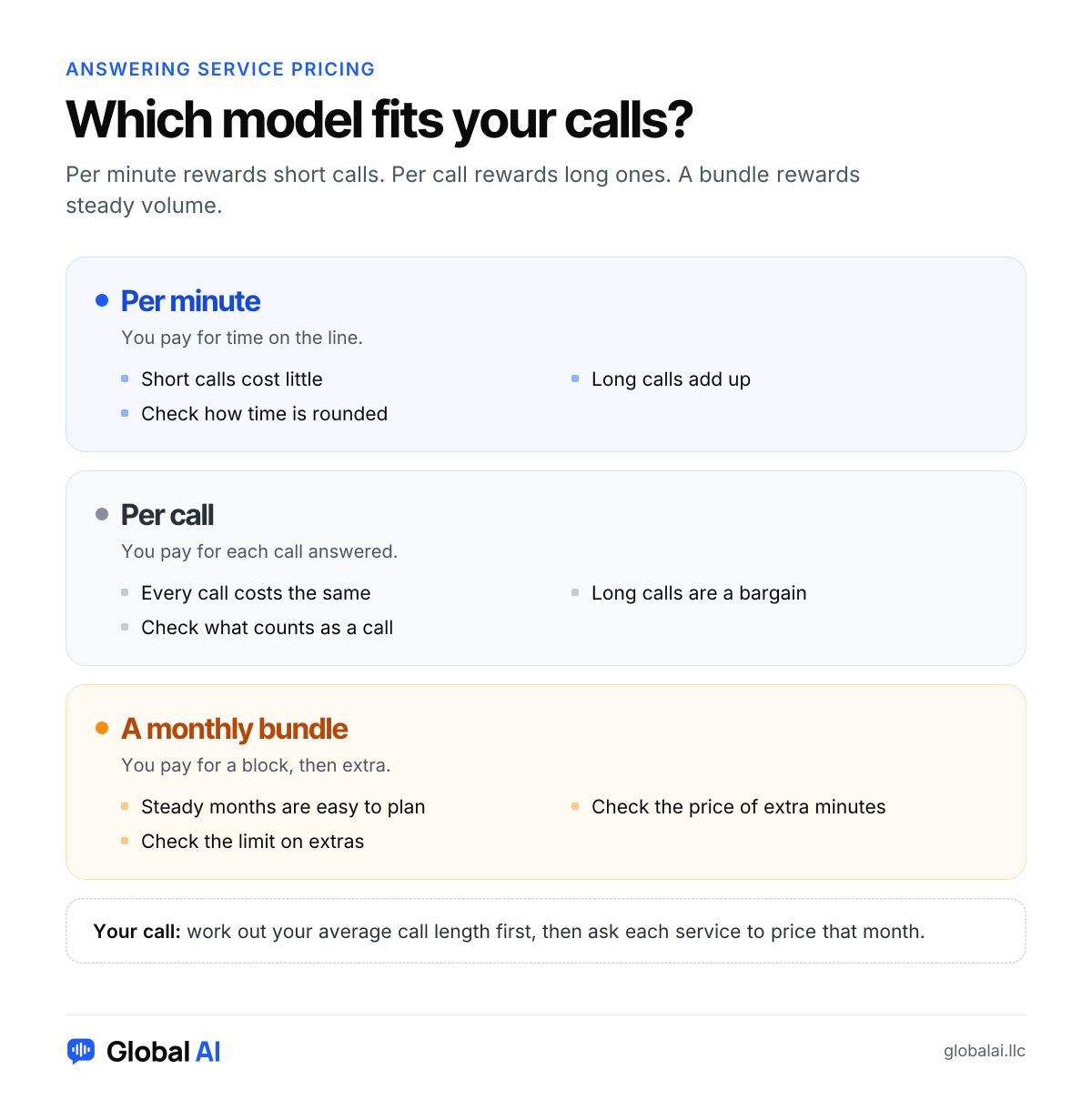
Skip the made-up rates. What changes the bill is the shape of the call, so here is how three typical calls land on each model, described rather than priced.
| Kind of call | Per minute | Per call |
|---|---|---|
| A 30-second hours question | Cheap, if time isn't rounded up | A full call charge for very little work |
| A 6-minute quote conversation | Adds up fast | The same charge as the short one |
| A wrong number or a hang-up | Cheap, if it's over in seconds | Ask whether it counts as a call |
A 30-second hours question
- Per minute
- Cheap, if time isn't rounded up
- Per call
- A full call charge for very little work
A 6-minute quote conversation
- Per minute
- Adds up fast
- Per call
- The same charge as the short one
A wrong number or a hang-up
- Per minute
- Cheap, if it's over in seconds
- Per call
- Ask whether it counts as a call
Two details sit underneath that table. The first is rounding: some services bill in whole minutes, so a 20-second call is charged as a full minute, while others bill in smaller steps. The second is the definition of a call. If a caller hangs up after the greeting, or someone calls back twice in ten minutes, does that count as one or two? Ask. The answer is almost never on the pricing page.
How do you find your own average call length?
Open your phone carrier's call log for the last month and pick twenty inbound calls at random, not the twenty that stick in your memory. Add the minutes, divide by twenty. If you can't get the log, time the next ten calls yourself. A rough average is enough, because the point is to know whether you're closer to one minute or five.
Then count the calls. A small shop with 100 calls a month is a round number to work with, so that is what the example below uses. Yours will be different, and that's the whole reason to do the exercise.
What does a flat bundle look like next to those two?
A bundle sits between the two. You pay a monthly price for a block of minutes, and anything over costs extra. Our Starter plan is $99 a month for 200 call minutes, with extra minutes at $0.25 each. Take 100 calls a month. At two minutes each that is 200 minutes, so the month is $99 with nothing extra. At three minutes each it is 300 minutes, which means $99 plus $25 for the extra 100: $124.
That's the advantage of a bundle: you can predict the month. It's also the weakness. If you take 40 calls in a quiet month, you've paid for minutes you didn't use. Per-minute and per-call pricing track your volume more closely, which is better for a business with big swings and worse for anyone who hates surprises on the invoice.
What should you ask before you sign?
- How is time rounded: to the second, to a full minute, to a longer block?
- What counts as a call? Hang-ups, wrong numbers, callbacks?
- Is there a monthly minimum, and does it apply in a slow month?
- Are there different rates after hours or on holidays?
- What happens when a busy month runs past the plan, and can you cap it?
The questions above are a short version of a longer list. If you're about to talk to a salesperson, our questions to ask an answering service covers the rest.
When is none of this the right way to buy?
If you take only a handful of calls a month, the arithmetic barely matters and any cheap plan will do. If your calls are the sort that need a human who can calm someone down or take a sensitive intake, the price model is the smaller question and the staffing is the larger one. And if you can't yet say what your average call looks like, don't sign a long contract. Ask for month to month and look at a real month.
An AI receptionist isn't automatically the cheaper answer either. It's a good fit for steady, repetitive calls like hours, booking and basic questions. It's the wrong fit for a business that mostly handles complicated calls where the caller wants a person.
Pricing questions owners ask
Is per-minute or per-call answering service pricing cheaper?
It depends on your average call length. Divide the per-call price by the per-minute price: if your calls run longer than that many minutes, per-call is cheaper, and if they run shorter, per-minute is.
What does a service count as a call?
It varies, and it is rarely on the pricing page. Ask whether hang-ups, wrong numbers and callbacks within a short window count as separate calls.
Do services round up to the next minute?
Some do. If a service bills in whole minutes, a 20-second call is charged as a full minute, so ask how time is rounded before you compare per-minute rates.
How is Global AI priced?
Monthly plans with included minutes. Starter is $99 a month for 200 minutes, and extra minutes are $0.25 each. You can set a monthly limit on extras.
Can I try it before committing?
Yes. The free trial includes 30 call minutes with no credit card, which is enough to measure your own average call length.
Price your own month
Use the free trial to see how long your real calls run: 30 minutes, no credit card, about 10 minutes to set up from your phone. Want to hear a call first? Ring Ava, our demo receptionist, at (856) 595-0295. Or call us at +1 (929) 286-5650 and ask us to walk through your numbers.