Guides · · 6 min read
How many answering service minutes does a small business need each month?
Most small businesses need fewer minutes than a plan sheet suggests. How to count your calls, turn them into minutes, and tell whether you're near a plan's limit.
By the Global AI team
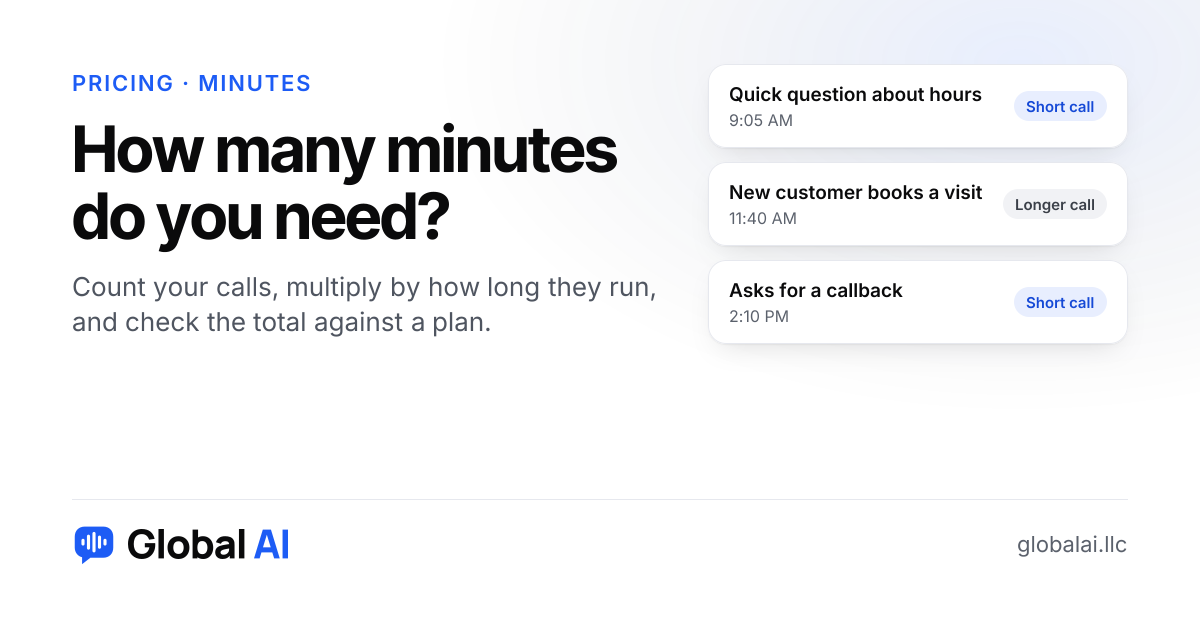
Take the number of calls you get in a month and multiply it by the average length of a call. That's the minutes you need. A shop that gets 60 calls and talks for about three minutes each needs roughly 180 minutes, then a cushion for the month that goes sideways.
Nobody should buy minutes by guessing. The good news is that you almost certainly have the numbers already, sitting in your phone carrier's call log. Our small business page shows what a receptionist does with the calls once you know the count.
How do you count your monthly calls?
Pull last month's call log from your carrier or your phone app and count incoming calls only. Then add the ones you missed, because those are the calls a receptionist would have caught. If you don't know how many you missed, count the voicemails and the numbers that rang once and hung up.
Pick a typical month, then look at your worst one. A landscaper's June and a plumber's January are not the same as their other ten months, and a plan sized for the quiet months will run out right when the phone matters most.
How long is an average call?
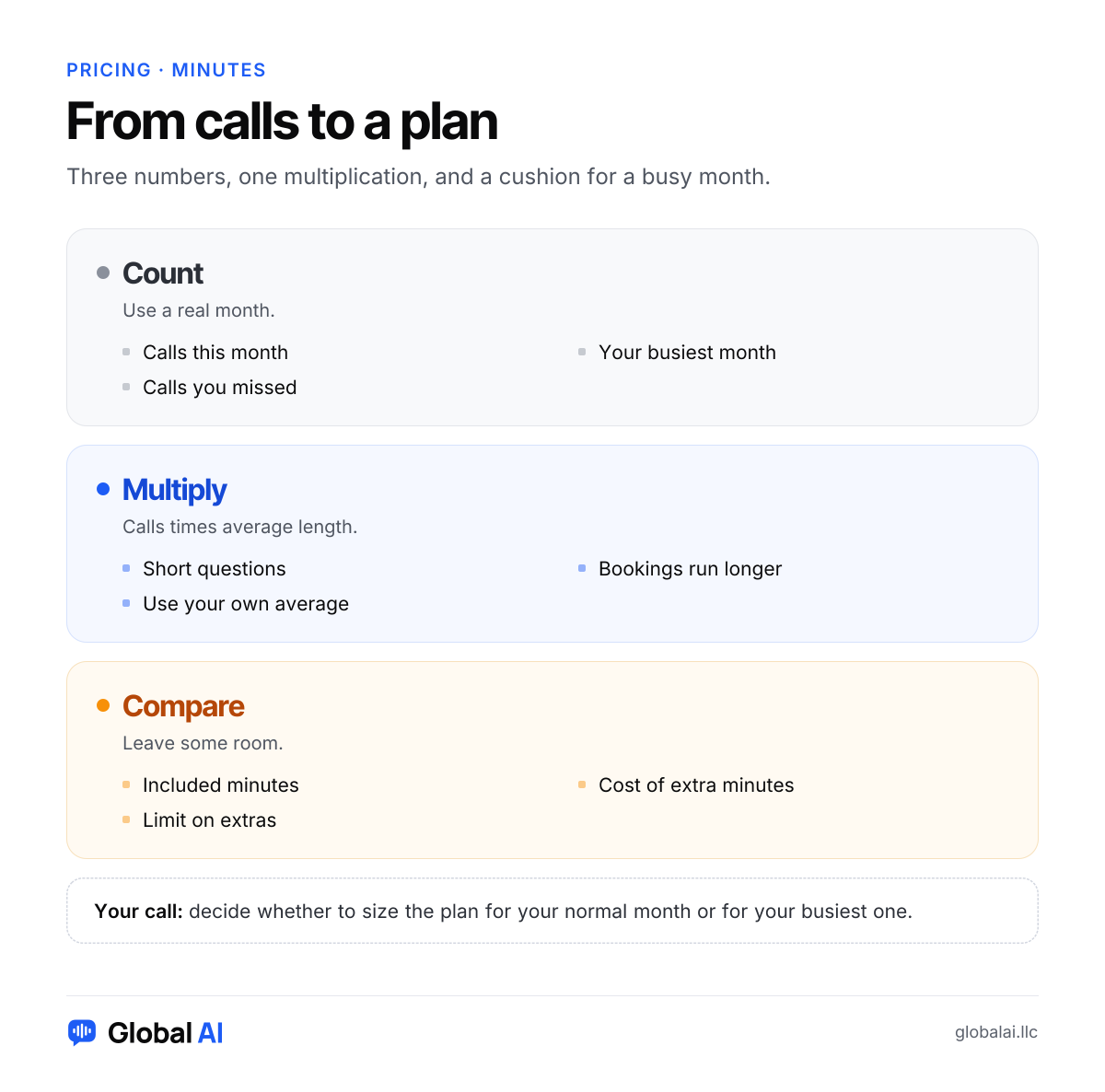
Short ones, like "are you open Saturday?", can be over in under a minute. A caller who wants to book a visit, give an address and describe a problem runs longer. For the examples below we use 3 minutes a call, which is a made-up round number, not a measured average. Your own calls could be shorter or longer, and your call log will show which.
What do 30, 60, 100 and 250 calls look like in minutes?
| Calls a month | Minutes used | Plan that fits |
|---|---|---|
| 30 | 90 | Starter, with 110 minutes to spare |
| 60 | 180 | Starter, with 20 minutes to spare |
| 100 | 300 | Starter plus extra minutes, or Growth |
| 250 | 750 | Growth, which includes 750 minutes and has no room to spare |
30
- Minutes used
- 90
- Plan that fits
- Starter, with 110 minutes to spare
60
- Minutes used
- 180
- Plan that fits
- Starter, with 20 minutes to spare
100
- Minutes used
- 300
- Plan that fits
- Starter plus extra minutes, or Growth
250
- Minutes used
- 750
- Plan that fits
- Growth, which includes 750 minutes and has no room to spare
Extra minutes are $0.25 each, and the standard limit on extras is $25 a month until you change it. That's the reason the 100-call row sits in an awkward spot: Starter can stretch to cover it, and that month costs $124, but only just.
If that's you most months, Growth is probably the better fit, and it also adds Google Calendar booking and live transfer to your team.
Why does the number move from month to month?
A cold snap, a storm, a promotion you ran, a Google listing that suddenly ranks. Calls cluster. One landscaper might get 20 calls in a rainy week and 90 in the week after the weather clears. If your business has a season, size for the season, or at least know what the extras would cost when it hits.
Check the billing rules of any service before you rely on a number. How a call is rounded, whether a hang-up counts, and what happens when you pass the limit all change what 'minutes' means in practice. We walked through those in what hidden fees look like on an answering service bill, and the per-minute and per-call comparison covers how the two ways of charging behave at different volumes.
For the wider picture of what an answering service costs, including setup fees and add-ons, start with the main cost guide.
How do you know you're getting close to the limit?
Watch the second half of the month, not the first. A plan that looks comfortable on the 10th can be nearly spent by the 20th if one busy week lands in the middle. The easy habit is a five-minute check on the same day each week: how many calls so far, and what's left. It's the same thing you'd do with a data plan on a phone.
Remember that the free trial is a sample, not a forecast. Thirty minutes shows you how long your own calls run and what your callers ask. It doesn't tell you what November looks like. Use it to replace the made-up three minutes with a number from your own business, then redo the multiplication.
When is counting minutes the wrong way to decide?
If you get fewer than a handful of calls a week, a plan sized by minutes is the wrong question. A decent voicemail greeting and a habit of calling back the same day may be all you need, and our look at the cheapest option for a one-person business goes through it. At the other end, if you take hundreds of calls a day that each need a person to judge something delicate, an AI receptionist is not the whole answer and a staffed front desk may be.
A last practical point: write the assumption next to the number. 'About 180 minutes, based on 60 calls at three minutes' is useful in six months, when you're wondering why you picked a plan. 'About 180' is not. Owners who keep that one line almost never overpay for a plan, because they can see at a glance what changed when the bill moves.
Questions about minutes and plans
How many minutes does a small business need?
It depends on your calls. Multiply the calls you get in a month by the average length of a call. At 3 minutes a call, 60 calls is about 180 minutes.
What happens if I go over my minutes?
Extra minutes cost $0.25 each, and the standard limit on extras is $25 a month until you change it.
Is website chat an extra cost?
Website chat is included on every plan.
How many minutes are in the free trial?
30 minutes, with no credit card. At 3 minutes a call that is about 10 test calls.
Can I change plans if my calls grow?
Yes. Pick the plan that fits now and move up when your own call numbers say so.
Count first, then try it
Write down last month's call count tonight. Then use the 30 free minutes to see how long your own kind of call really runs. The demo line is (856) 595-0295, you can start free with no credit card, or call us at +1 (929) 286-5650 and we'll look at your numbers with you.