Guides · · 6 min read
How should a roofing company handle a week of calls in one day after a storm?
After a storm, roofing calls land all at once. Which ones go first, what to ask on every call, how to stop the estimate backlog, and what to do before the next one.
By the Global AI team
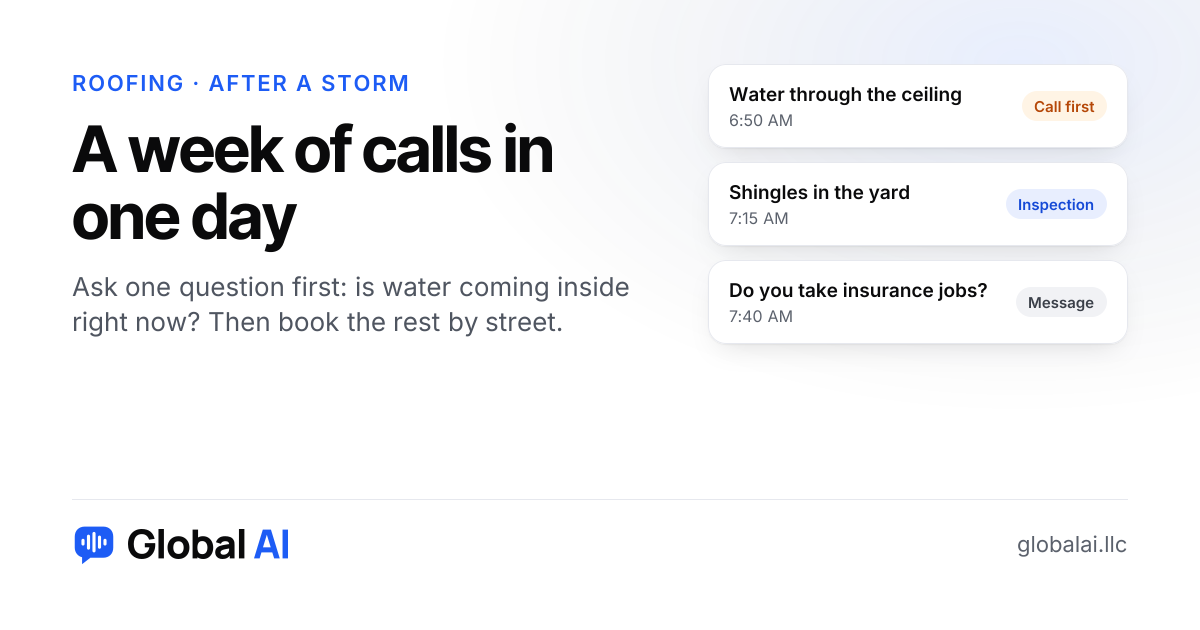
Answer every call, ask whether water is coming inside right now, and book everyone else by street instead of in the order they rang. That's the short version of how a roofing company gets through a week of calls in one day after a storm. The harder problem shows up on day three, when the estimates are stacked up and you're still one person.
What really breaks after a storm?
It's rarely the phone alone. On the Roofers Coffee Shop forum, a roofer buried in repair leads after heavy rain wrote: "I am the only one running these leads and now im already at least a week back just giving estimates!" Read that again. The leads were there. The bottleneck was one person and a list that kept growing.
So the phone has one job that day: turn a mess of callers into a list you can drive. A name and a voicemail don't do that. An address, and whether the inside of the house is dry, will.
You'll see big percentages online about how far call volume jumps after hail. They mostly come from companies selling answering services, and we couldn't trace them to anything we'd trust, so we're not repeating them. You know your town and your last storm. Plan for that.
Which calls should you return first?
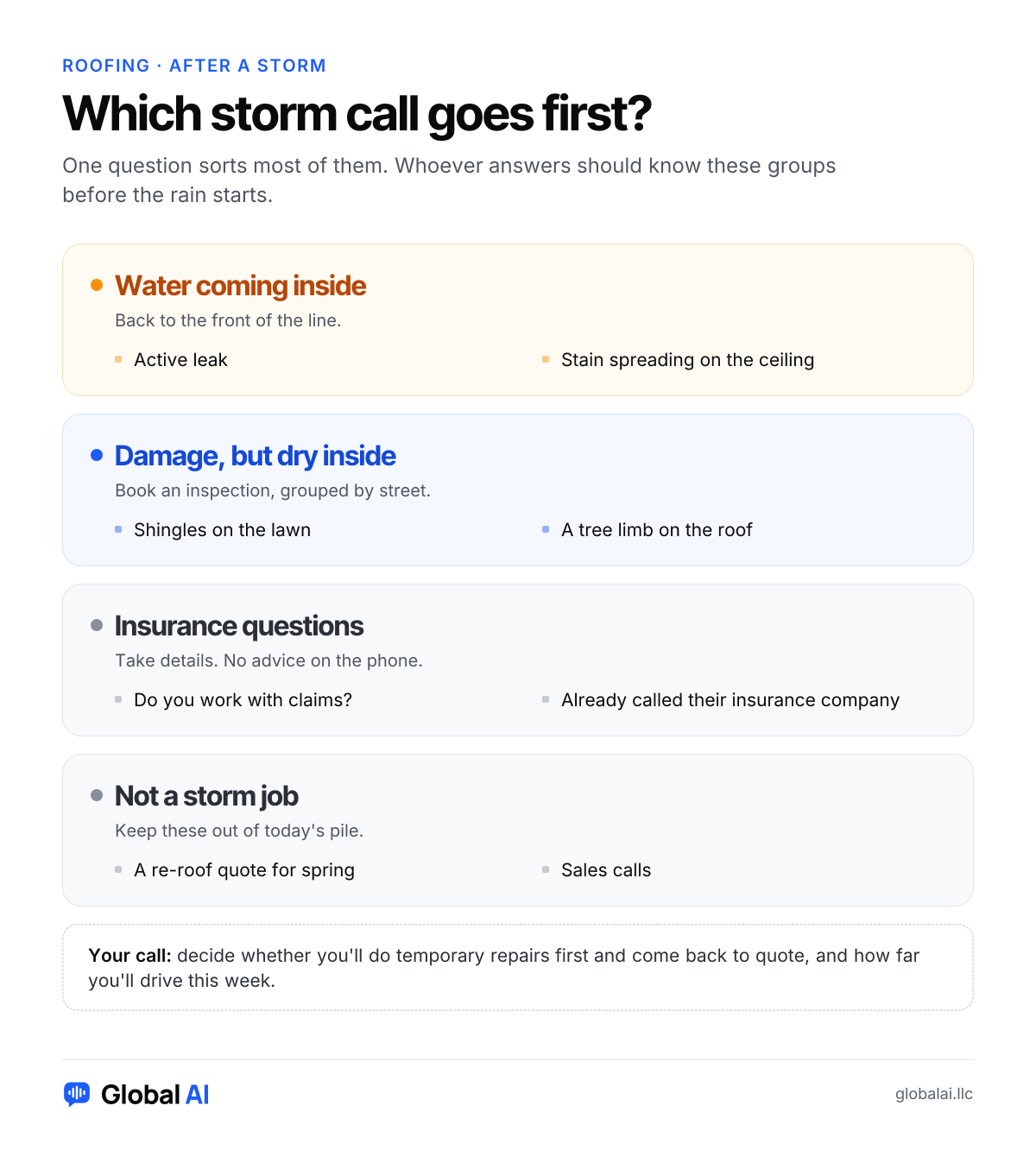
Water inside jumps the line, because that homeowner is watching it get worse. Everything else can wait a day if the caller knows it's on your list. The call you lose isn't always the one you missed. It's the one who left a message, heard nothing by dinner and rang somebody else. A re-roof quote for spring and the sales calls that show up with every storm stay out of today's pile.
What should you ask on every storm call?
- The street address, plus the nearest cross street.
- Is any water coming inside right now?
- What did they see? Shingles on the lawn, a tree limb, a stain on the ceiling.
- Have they already called their insurance company?
- The best number to reach them, since many will be out of the house.
Keep it to that. A long intake on the worst morning of someone's month gets you a hang-up. It's also why you shouldn't ask anyone answering your phone to judge damage or explain coverage. Our receptionist won't give insurance advice. It can share what you've told it about how you work with claims, then take the details for you.
How do you keep the estimates from piling up?
The roofers in that same thread had good answers. One crew writes the estimate on site: "We prepare the written estimate before leaving the driveway." Another wanted temporary repairs booked first and full quotes later, so he wasn't "driving all over the countryside and not generating income." A third warned against loading up on junk repairs too fast. Those are different bets, and each one is yours to make.
What helps with all of them is route order. If the list is sorted by street, one drive covers six roofs. If it's sorted by when people called, you cross town four times before lunch. And tell callers the truth about timing. "We're booked out about a week for inspections, and you're on the list" keeps more people than a promise you'll break on Thursday.
What are homeowners checking before they call you back?
Your caller may already have had somebody knock on the door. The Federal Trade Commission warns homeowners that unlicensed contractors and scammers often appear in recovery zones, and tells them a refusal to share a license, insurance or a written contract is a red flag. A legitimate roofer can use that. Have your license details, proof of insurance and how you handle contracts ready for the first call, written down wherever your receptionist or office can find them.
What should you set up before the next storm?
Run the numbers on a bad week now, on a dry day. On Starter, $99 a month covers 200 call minutes, and extra minutes are $0.25 each up to your limit. At the standard $25 limit, that's 300 minutes in the month, or about 100 calls if each runs three minutes. Past that it takes messages instead of booking. If your last storm was bigger than that, raise the limit before the season rather than during it.
Plan features matter here too. Starter takes booking requests that you confirm, and urgent calls are flagged and sent to you on every plan. Google Calendar booking and live transfer to you or an office helper start on Growth, which is $249 a month for 750 minutes. Texting homeowners isn't available yet, so plan on callbacks.
When is an AI receptionist the wrong tool for storm calls?
Office staff who can take every call already do this job, so you don't need one. A company whose storm work comes through insurance relationships or a sales team knocking doors has a different bottleneck than the phone. A roofer already a month out and turning work away is the clearest case, because more answered calls just means more people to disappoint. Fix capacity first. Our guide on missed calls in a home service business can help you tell which problem you've actually got.
Questions roofers ask about storm calls
Can an AI receptionist handle a rush of calls at once?
Yes. It answers each call as it comes in, so nobody waits on hold or hits a busy signal. Each one is summarized for you afterward.
Will it talk to homeowners about their insurance claim?
It won't give insurance advice. It can share what you've told it about how you work with claims, and take the details so you can follow up.
Can it tell a leak from a cosmetic problem?
It asks whether water is coming in and flags urgent calls to you right away. It doesn't assess the roof. That's your job on site.
Can it text homeowners an inspection time?
Not yet. Text messages are coming soon. Today it answers calls and website chats and emails you each booking and message.
Do I have to change my business number?
No. Keep your number and forward calls all the time, only when the line is busy, or only after hours.
Before the next forecast
Call Ava at (856) 595-0295 and pretend your ceiling is dripping. You'll know within a minute whether you'd want your customers hearing it. If so, setup takes about 10 minutes from your phone, and your first 30 minutes are free, with no credit card.