Guides · · 6 min read
How do you switch from an answering service to an AI receptionist without missing calls?
A practical plan for moving from a live answering service to an AI receptionist: what to check in your contract, how to run both for a while, and when to stay put.
By the Global AI team
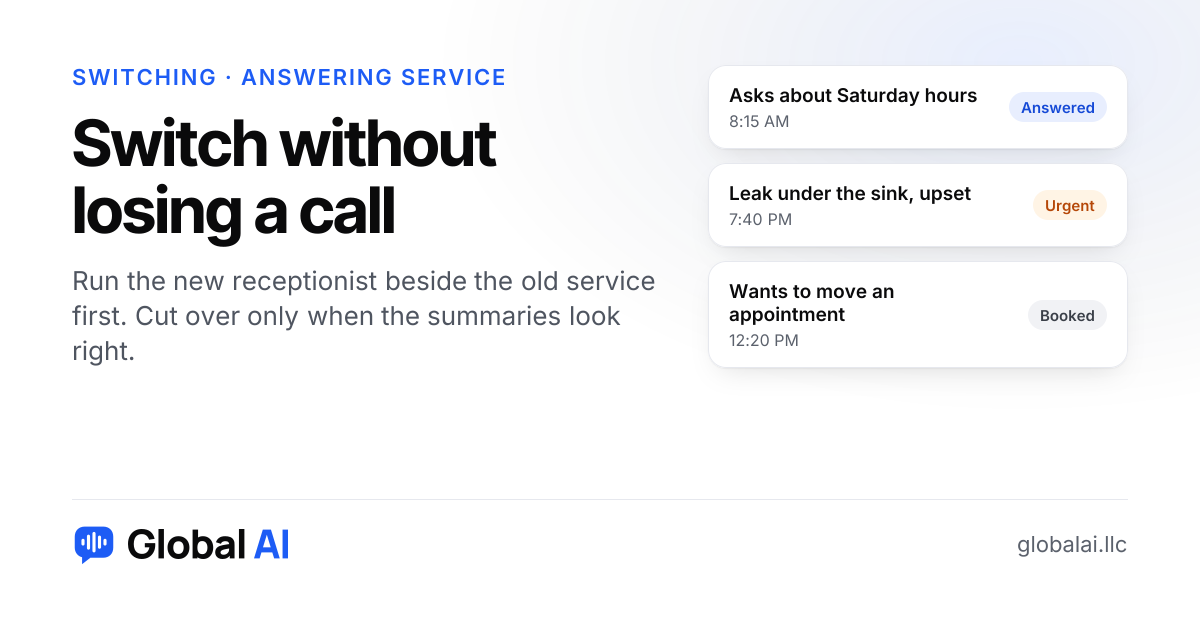
You can switch from a live answering service to an AI receptionist in an afternoon, but you shouldn't cancel the old service that day. Keep your phone number, forward a small slice of calls to the new receptionist, read what it gives you for a week or two, and cancel only when the summaries are as good as the messages you were getting before. Done that way, no caller falls into a gap.
Why do owners switch in the first place?
The reasons are usually small and repeated. A message that arrives with the caller's name spelled wrong. A bill that jumps because a busy month ran over the included minutes. Nobody on the other end who knew you'd changed your Saturday hours three weeks ago. None of that is a scandal. It adds up, and one morning you're reading a message that says "customer called, wants a call back" and you wonder what you're paying for.
A good live service is still worth keeping for some businesses. More on that below. If your main frustration is cost or slow updates, though, it's worth a look at how the two compare.
What should you check before you cancel anything?
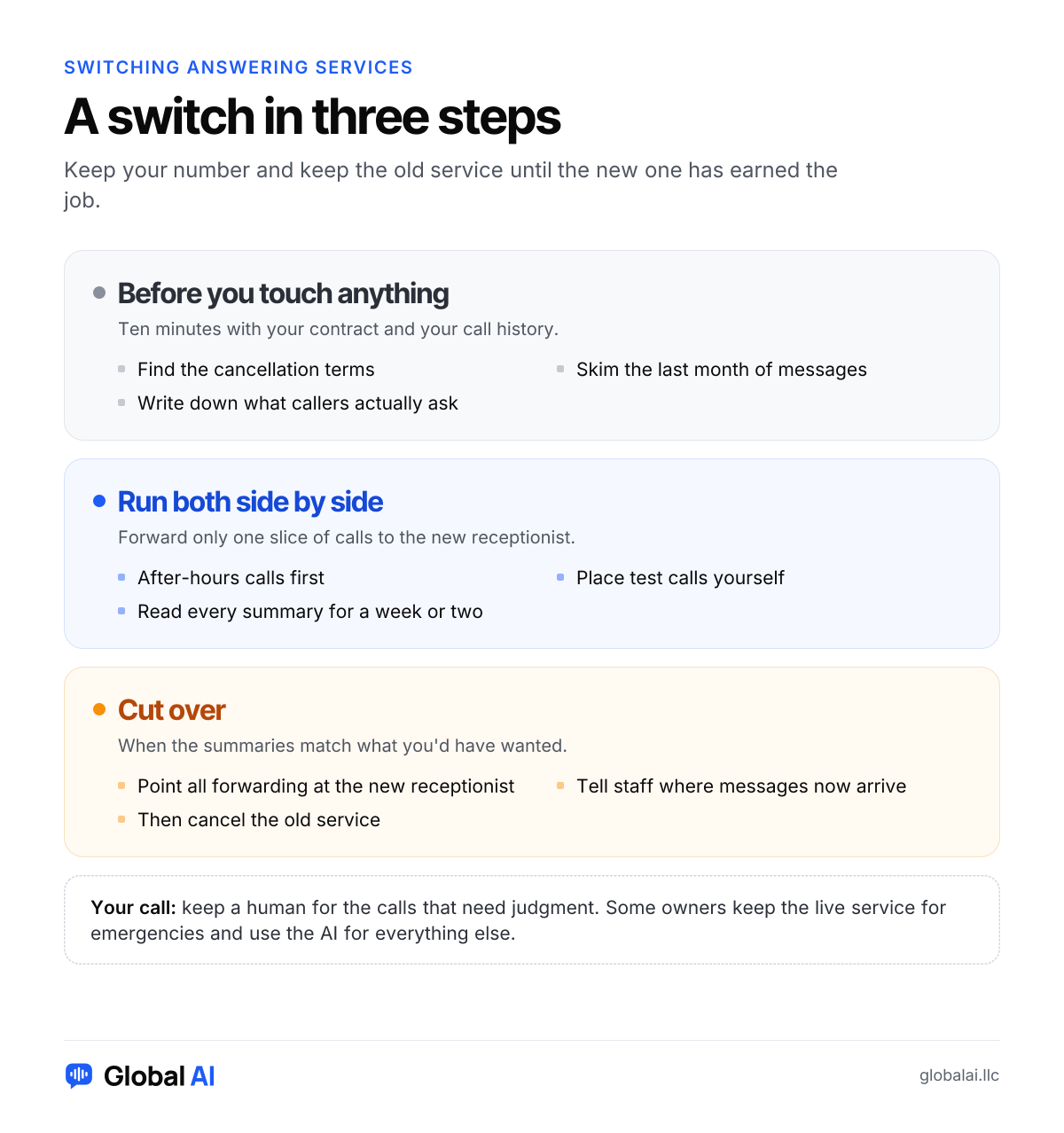
Start with the contract, because that decides your timeline. Look for a minimum term, a notice period and whether cancelling mid-month still bills you for the full month. If it's unclear, ask the service in writing. It's a boring ten minutes that can save you a month of paying for two things.
Then read the last month of messages. Highlight the questions that come up again and again: hours, prices, whether you serve a certain area, how to book. Those become the answers you give your new receptionist, and they're usually a shorter list than you'd guess.
How do you run both at the same time?
Keep your number. You're not changing it, you're changing where calls are forwarded. Forwarding is a setting at your phone carrier, and you can point it at the new receptionist for only some situations: after hours, when you don't answer, or all the time.
The safest first slice is after hours. Evenings and weekends are when a mistake costs you least, because the old service can keep covering your daytime calls. Before forwarding anything, call the number yourself from a second phone. Ask the dumb questions a customer would ask. Ask something you haven't taught it, and listen to how it handles not knowing.
The free trial exists for exactly this. You get 30 call minutes with no credit card, which is enough to test a handful of real calls. Setup takes about 10 minutes from your phone, and here's how it works.
When is it safe to cancel the old service?
Wait for a run of calls where you'd have made the same choices yourself. Read the summaries, not the highlights. Did it get the callback number right? Did it mark the angry caller as urgent? Did it send someone who wanted a quote to the right place? One odd call is a reason to adjust the instructions. A pattern of them is a reason to wait.
When you do cut over, tell whoever reads your messages where they now arrive. It's a small thing that gets forgotten, and it's how a whole morning of messages goes unread.
What does it cost to switch?
Global AI plans start at $99 a month for 200 call minutes, and extra minutes are $0.25 each. Your old bill is the thing to compare against, not a quote from anyone's website. Pull the last three invoices and divide by the number of calls. If you're not sure which plan fits your volume, the pricing page shows the differences.
One difference matters if you've been used to a human patching calls through. Live transfer to your team and Google Calendar booking are on the Growth plan and up, not on Starter. On Starter, urgent calls are flagged and sent to you right away so you can call back, and bookings arrive as requests for you to confirm.
When should you stay with your answering service?
If most of your calls are emotional or complicated, such as a law office taking in a new matter or a clinic fielding anxious patients, a trained human is hard to replace. The same goes if callers regularly need someone to make a judgment call that you can't write down as a rule. An AI receptionist follows the instructions you give it. It doesn't read between the lines the way a person who has worked your desk for years does.
And if your service is working, your messages are good and your bill is fair, don't switch for the sake of it. A hybrid is a perfectly sensible answer: a person for the calls that need one, an AI for the volume. That's a setup many small shops end up with.
Questions owners ask about switching
Do I have to change my business phone number?
No. You keep your number and forward calls to your receptionist after hours, only when you don't answer, or all the time. Switching back is just changing the forwarding setting.
Can I run an AI receptionist alongside my current answering service?
Yes. Forward only some calls, such as after-hours ones, to the new receptionist while the old service covers the rest. Compare the messages for a week or two before you cancel anything.
Will I be able to read what callers said?
Every call is transcribed and you get a summary of each one. Audio recording is a setting you control, and callers are told at the start of the call.
Can it transfer a call to me live, like my service did?
Live transfer is on the Growth plan and up. On every plan, urgent calls are flagged and sent to you right away so you can call back.
Can it text callers a confirmation?
Not yet. Text messages are coming soon. Today it answers calls and website chats and emails you new bookings and messages.
Try it next to your current service
Start with 30 free minutes, no credit card, and keep your answering service running while you test. Want to hear it first? Call Ava, our demo receptionist, at (856) 595-0295 and ask her something your customers would. If you'd rather talk to a person, call us at +1 (929) 286-5650.