Guides · · 6 min read
Do you need a Spanish-speaking receptionist to serve Spanish-speaking customers?
What happens when a caller can't be understood, what a Spanish-capable AI receptionist does well, and the calls where you still want a person who speaks Spanish.
By the Global AI team
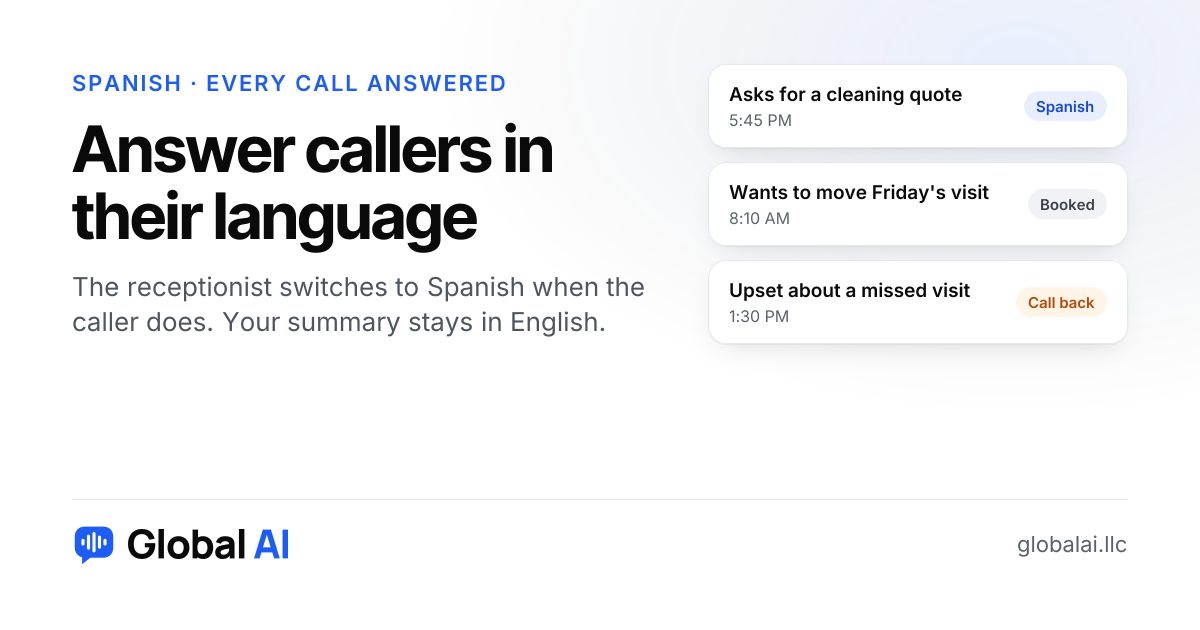
Not always. What you need is for a Spanish-speaking caller to be understood, to get the same hours, prices and answers as everyone else, and to leave details you can act on. A receptionist that switches to Spanish when the caller does can cover the routine calls. For sensitive ones, you still want a person who speaks Spanish.
What actually goes wrong when a caller can't be understood?
Picture a cleaning company at 5:45 on a weekday. A woman calls asking, in Spanish, what a deep clean costs for a two-bedroom apartment. The person who answers says "one moment" in English, puts her on hold, and then the line goes to voicemail. She doesn't leave a message in her second language. She calls the next company on the list.
Nobody did anything wrong in that story. There just wasn't a bilingual person in the building at that minute, and the cost is a quote you never got to give. The same thing happens at salons, restaurants, landscaping crews and repair shops. You don't see it, because the lost caller never shows up in your numbers.
How does an AI receptionist handle Spanish?
Global AI Receptionist answers in English and switches to Spanish the moment a caller speaks it, then finishes the whole call in Spanish. It tells the caller in Spanish that it's a virtual assistant. It uses the polite "usted" unless the caller uses "tú" first. If the caller drifts back to English for a full sentence, it follows them.
You don't write anything twice. Hours, prices and policies go in once, in English, and the receptionist gives callers the same facts in Spanish. If a question isn't covered, it says your team will follow up instead of guessing. That last part matters more than it sounds. A confident wrong answer in any language is worse than "someone will call you back."
On your side, nothing changes. The summary of every call is in English, and a Spanish call starts with a note that the caller spoke Spanish. If you want to check what was really said, the transcript is in Spanish.
How do you set it up so it works?
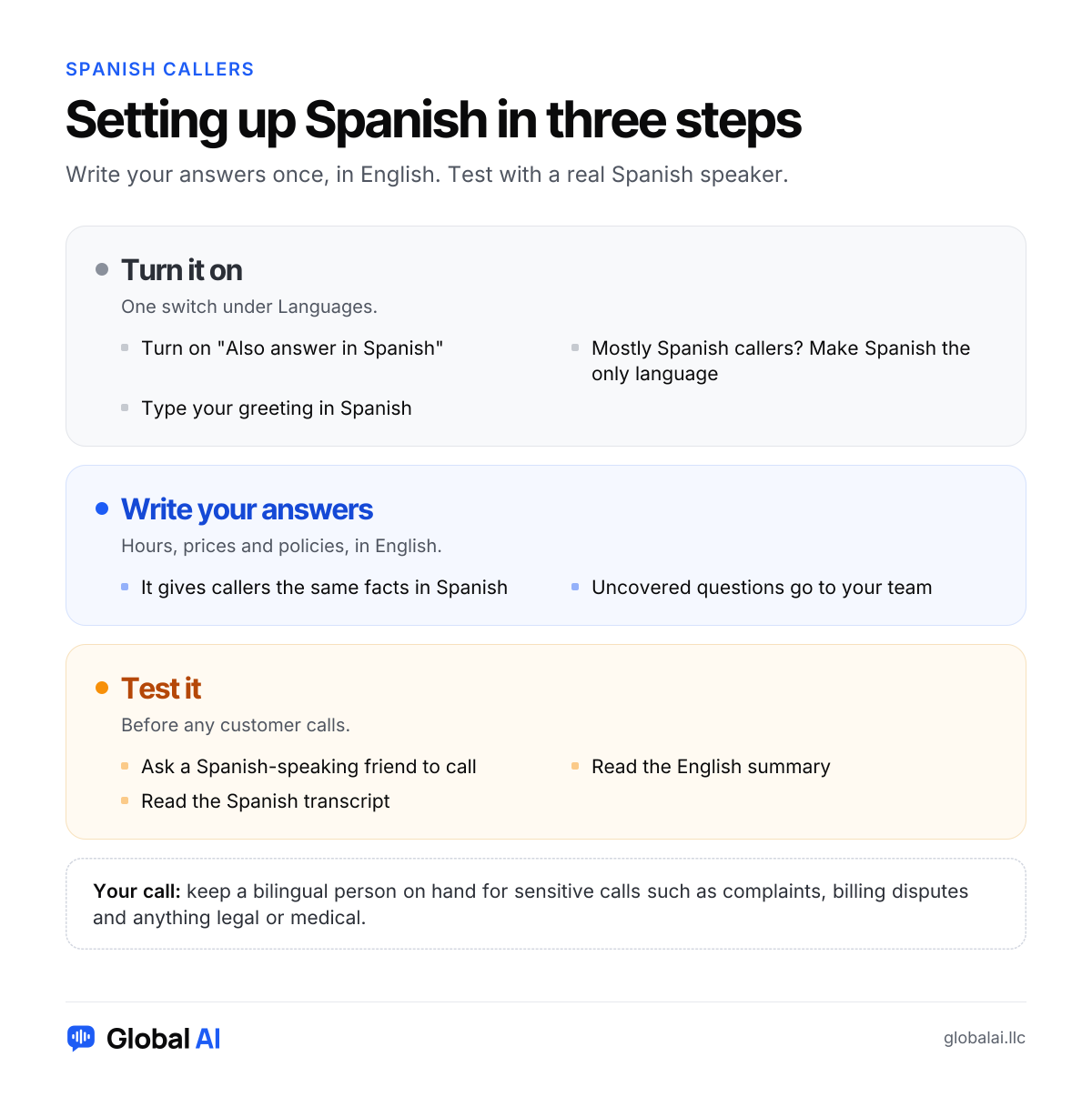
The switch is called "Also answer in Spanish" and it's under Languages. If most of your callers speak Spanish, you can make Spanish the only language and type your greeting in Spanish, because the standard greeting is in English. Otherwise leave English first and let it switch on its own.
Then do the thing nobody does: have a Spanish-speaking friend, employee or neighbor call and ask real questions. You're testing whether your answers make sense when they come out in another language. Spanish is included on every plan, including the free trial, and a Spanish call uses minutes the same way an English one does. Plans start at $99 a month.
Which businesses benefit most?
That depends on your neighborhood, not on a national average. Look at your own voicemail from the last two months and count the messages in Spanish, or the calls where somebody hung up after the greeting. A cleaning company, a landscaping crew or a restaurant with a lot of phone orders will often find more than they expected. A downtown tax office might find none.
If you already have a bilingual teammate, that person is probably answering every Spanish call and every Spanish voicemail too, on top of their real job. Handing the first-contact part to a receptionist gives them their afternoon back.
When is it not the right fit?
Be honest about the calls that carry weight. A customer disputing a charge, a patient describing symptoms, someone asking about a contract: those calls need a person who can hear tone and use judgment, in whatever language the caller prefers. An AI receptionist can take the message and mark it urgent, but it shouldn't be the one making the call.
Two practical limits. Live transfer to your team is on the Growth plan and up, not Starter, so on Starter an urgent Spanish call is flagged and sent to you to call back. And texting callers isn't available yet in any language, so confirmations come by phone and email for now. If many of your customers expect a text back, plan around that.
Questions owners ask about Spanish callers
Does Spanish cost extra?
No. Spanish is included on every plan, including the free trial. A call in Spanish uses minutes the same way as a call in English.
Will Spanish-speaking callers know it's an AI?
Yes. When it switches to Spanish it says so in Spanish, and it mentions that the call is recorded and transcribed unless you turned recording off.
Do I have to write my answers in Spanish?
No. Write your hours, prices and answers in English. It gives callers the same facts in Spanish, and says your team will follow up if something isn't covered.
Can I read the call summary in English?
Yes. Summaries are always in English, and a Spanish call starts with a note that the caller spoke Spanish. The transcript shows what was said in Spanish.
Can it send a Spanish text message to confirm a booking?
Not yet. Text messages are coming soon in every language. Today it answers calls and website chats and emails you every booking and message.
Hear it on your own greeting
Start with 30 free minutes, no credit card, turn on Spanish and ask someone to call in Spanish before any customer does. Setup takes about 10 minutes from your phone. Questions first? Call us at +1 (929) 286-5650.