Pricing · · 6 min read
How much does an answering service cost for your type of business?
A plumber, a salon and a cleaner can all pay different bills for the same service. What moves the price is your calls, not your trade, and here is how to count them.
By the Global AI team
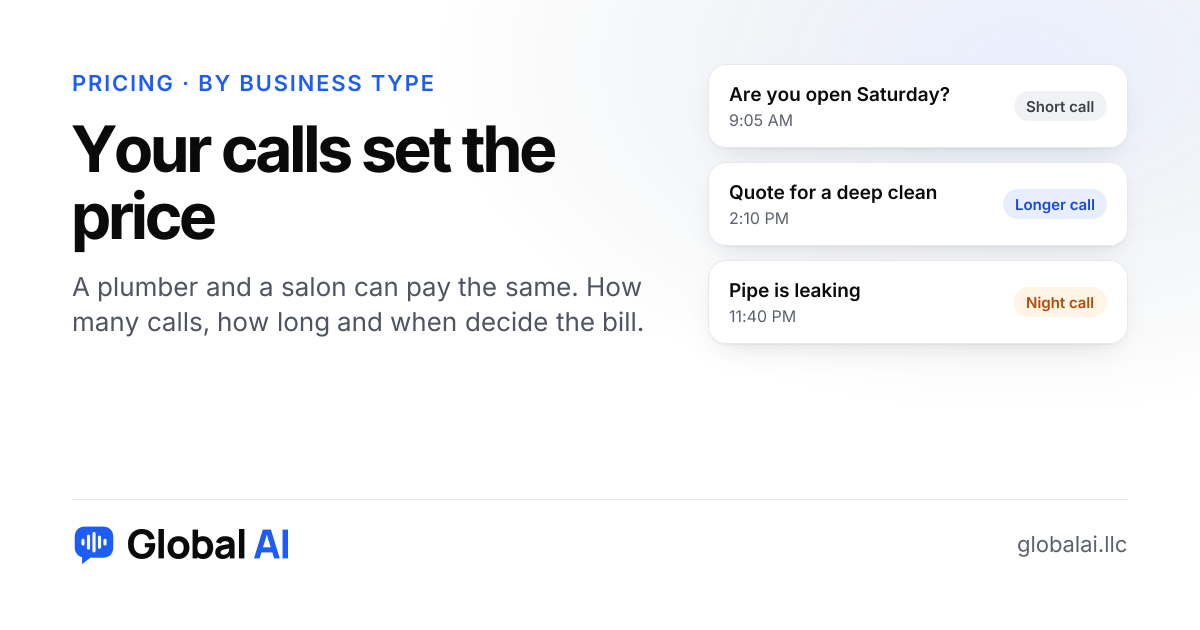
It depends on your calls, not your trade. Two plumbers can pay very different bills, and a plumber and a salon can pay about the same. What sets the price is how many calls you get, how long each one runs and when they come in, so count those before you compare a single quote.
Why does the same service cost different businesses different amounts?
Because nearly every plan bills on time, on calls or on a mix, and a type of business is shorthand for a call pattern. A cleaning company gets a few quote requests a day and each takes a minute or two of questions. A salon gets a rush of short "do you have an opening?" calls on Saturday morning. A plumber gets fewer calls overall, but the night ones run long because the caller is stressed and has a lot to explain.
So when a website lists prices "for plumbers" and "for salons", look past the label. The useful question is what a normal month of your calls adds up to, and whether the plan bills per minute or per call changes the answer.
What moves your bill the most?
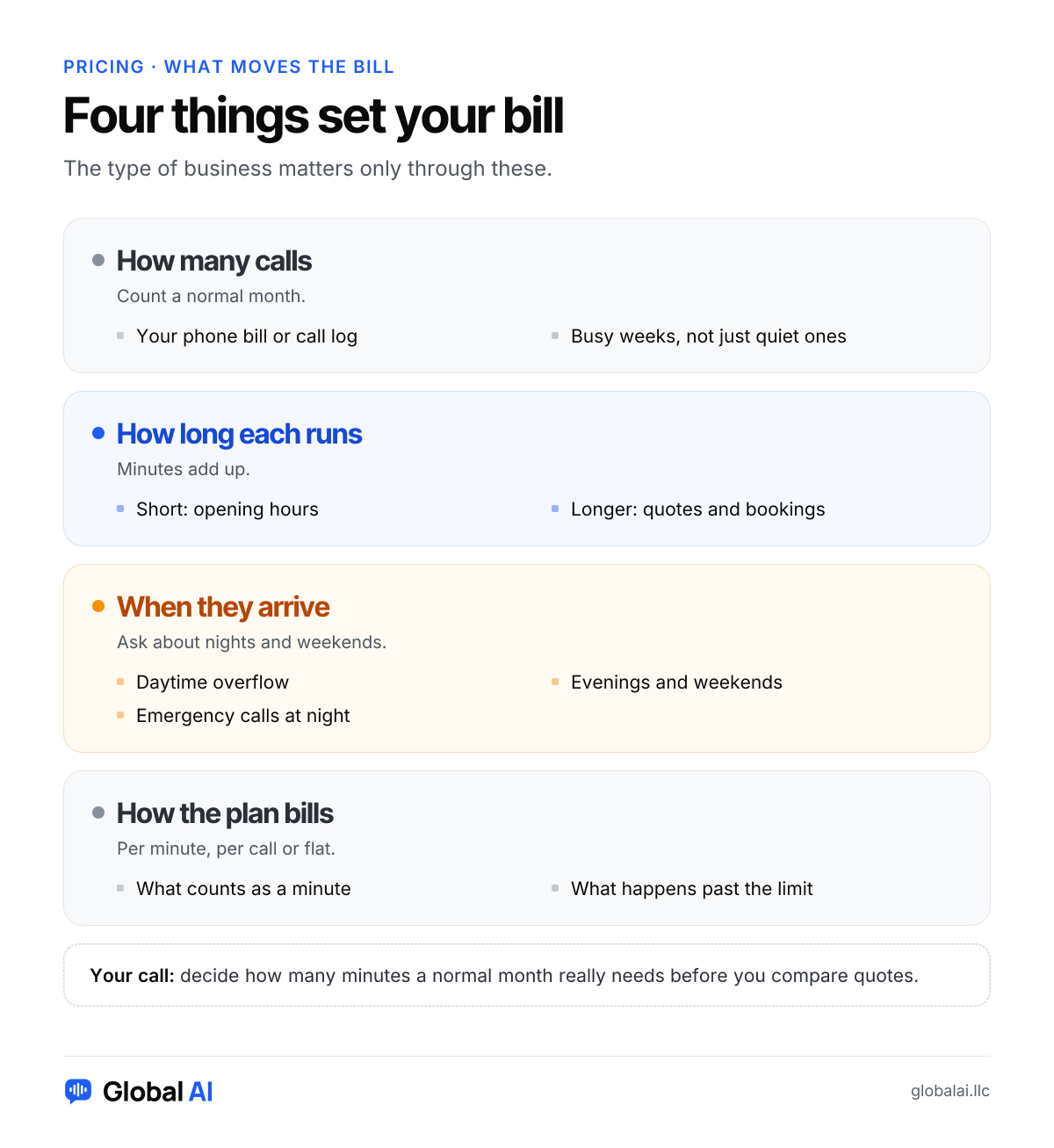
Volume comes first. If you don't know yours, your phone company's call log for the last month is a decent start, and so is a week of tally marks on a sticky note. Count the busy weeks as well as the quiet ones, because a plan sized for February will be too small in your peak season.
Length is second, and it's the one owners guess worst. A question about opening hours is over quickly. A caller who gives an address, describes a problem and picks a day takes longer. If most of your calls are the second kind, plan for it.
Timing is third. Some services charge differently for nights and weekends, some don't, and you only find out by asking. And the way a plan bills decides what a busy month does to you, which the cost guide walks through with a worked example.
What would a cleaner, a plumber, a salon and a gym actually use?
| Business | Calls a month | Minutes used | Plan that fits |
|---|---|---|---|
| Owner-operator cleaning company | 40 | 120 | Starter, with 80 minutes to spare |
| Plumber | 90 | 270 | Starter plus extra minutes, or Growth |
| Hair salon | 150 | 450 | Growth, with 300 minutes to spare |
| Gym with a busy front desk | 300 | 900 | Growth plus extra minutes, or Scale |
Owner-operator cleaning company
- Calls a month
- 40
- Minutes used
- 120
- Plan that fits
- Starter, with 80 minutes to spare
Plumber
- Calls a month
- 90
- Minutes used
- 270
- Plan that fits
- Starter plus extra minutes, or Growth
Hair salon
- Calls a month
- 150
- Minutes used
- 450
- Plan that fits
- Growth, with 300 minutes to spare
Gym with a busy front desk
- Calls a month
- 300
- Minutes used
- 900
- Plan that fits
- Growth plus extra minutes, or Scale
Those volumes are invented to show the arithmetic, not measured from any real business. The plumber's row is the interesting one. At 270 minutes, Starter runs 70 minutes over, and at $0.25 a minute that month costs $116.50, inside the standard $25 limit on extras. If it happens every month, Growth is the cleaner choice, and it also adds Google Calendar booking and live transfer, which Starter doesn't have.
A solo cleaner sits comfortably on the smallest plan. The gym is past what Growth includes, so it's a Scale conversation or a decision about the extras limit.
What should you ask any answering service before you sign?
Ask what counts as a minute: ringing, hold time, the greeting. Ask what happens past your limit and whether there's a ceiling you set. Ask for the night and weekend rate in writing if you want calls covered then. And ask what you pay in a month with no calls, because some bills carry a base fee whatever happens. The hidden fees guide has a longer list.
If you've already read a few quotes, put them side by side with your own call count. Where one of them is much cheaper, find out what is missing before you celebrate.
When is paying for an answering service not worth it?
If you get a dozen calls a month and can call everyone back the same day, voicemail and a good callback habit cost nothing. If your calls are long consultations where your own judgment is the product, a service only takes the details and you still do the talking. If you're busy all day, every day, and the volume is high and steady, a person on payroll can come out ahead, and the comparison with hiring is worth running with real wages.
An AI receptionist also isn't right if your callers must reach a live person every time. It takes the caller's details and tells you, and on Growth and up it can pass a call through to you, but it's not a staffed call center.
Answering service cost questions
How much does an answering service cost for a small business?
There's no single number. It depends on your calls, their length, when they arrive and how the plan bills. Global AI starts at $99 a month with 200 call minutes included.
Does a plumber pay more than a salon?
Not because of the trade. A business pays more when it uses more minutes, so whichever one gets more and longer calls pays more.
Do nights and weekends cost extra?
That depends on the service, so ask for the night and weekend rate in writing. Global AI plans count call minutes, and the pricing page lists what each plan includes.
What happens if I go over my minutes?
Extra minutes are $0.25 each, and the standard limit on extras is $25 a month until you change it.
Can I try one before I pay?
Yes. The free trial has 30 call minutes and needs no card, so you can see how many minutes your own calls use.
Count a month of calls, then compare
Pull last month's call log, multiply by the minutes you think a call takes, and compare that to a plan. Then start free, or hear a call first on the demo line at (856) 595-0295. If you'd like help sizing it, call +1 (929) 286-5650.